Which lens each room actually needs
6 November 2026
Walk into a shoot with one lens and the whole hotel starts speaking in the same breath. The lobby feels as tight as the bed. The plate feels as wide as the lobby. A guest does not live it that way. They look in from the door, then they step into the room, then at night they lean over a plate.
A smaller millimetre fits more into the picture. On a full-frame camera, 16 mm is wide and makes a room feel larger than it is. 35 mm is close to what you see if you stand inside and turn your head a little. 50 mm is like looking at one thing. 85 mm brings a far detail to your side and softens what sits behind it. So which one does the lobby want, which one the room, which one the plate?
The lobby should feel open, and the walls should stay straight
People pause when they enter a lobby. Is the ceiling high, is the desk far, where is the light coming from. On a full-frame camera a 16-35 mm is enough to show that. At 16 mm the desk, the ceiling and the door meet in one frame. The room opens up. A guest feels let in while they are still on the threshold.
24 mm is calmer. A column does not swell, and the lamp in the corner does not stretch. The lobby still feels large, and the person who walks in does not resent the photo. At 14 mm, and with a fisheye, it falls apart. A person at the edge grows long, and a straight wall bows. Openness is lovely. A hotel that turns into a toy is not.
If you want the near end of the lobby and the far end both sharp, close the aperture down. The aperture is the hole the lens takes light through. Between f/8 and f/11 that hole is small. The desk is sharp, and so is the far wall. When the light drops, the shutter slows and the camera shakes. That is what the tripod is for. Keep the ISO low. Marble and wood should not break into sand.
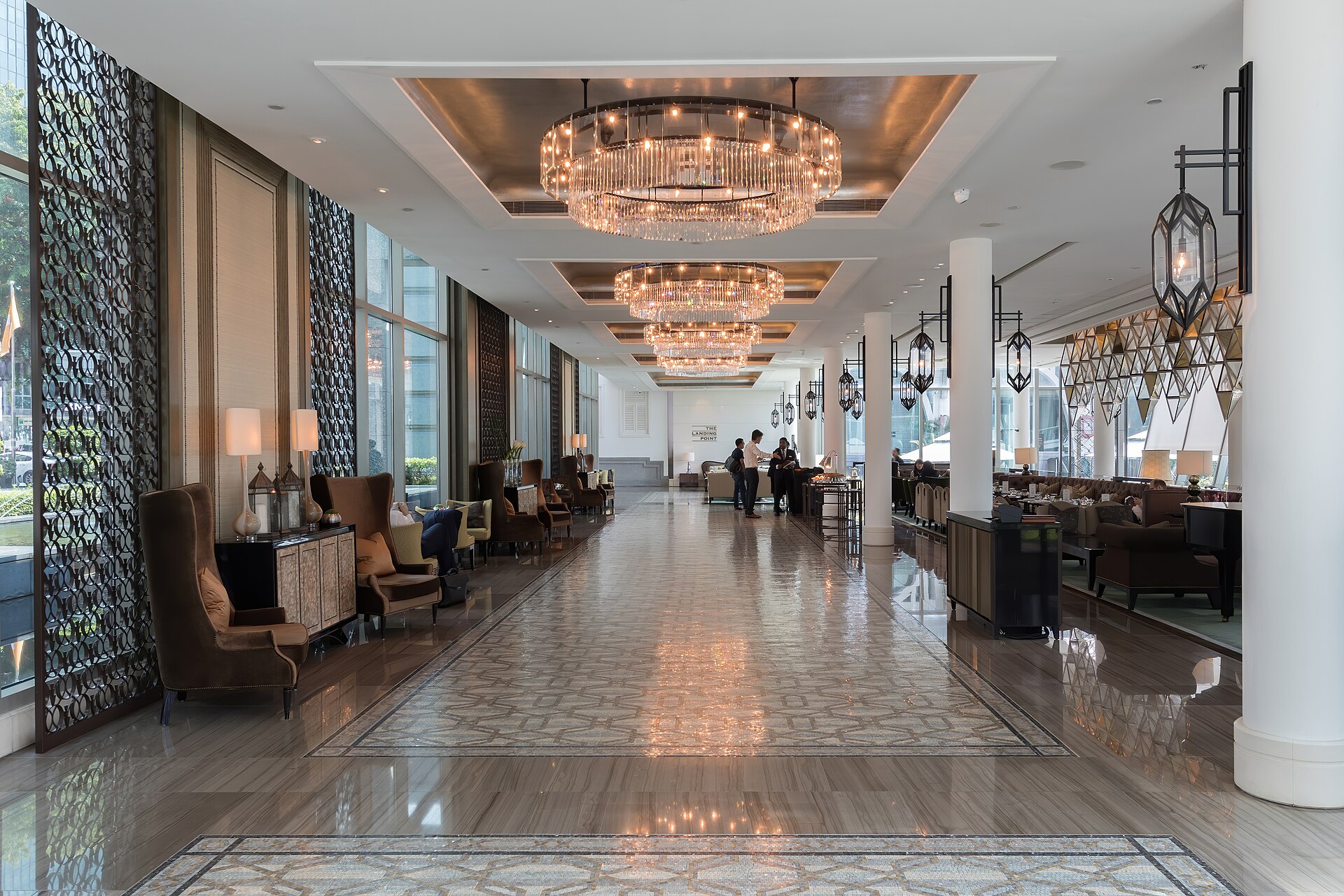
The lobby below is the Fullerton Bay, in Singapore. Full frame, 24 mm, aperture f/9. The ceiling, the chandeliers and the desk sit in one glance. The walls are still upright.
A plate and a cloth want to be seen up close
Hold a wide lens over a plate and the near edge swells while the far edge slips away. The food looks spilled. That is not what we want at a table. We want appetite.
35 mm builds the dining room. From a corner the tables line up one after another, and the room looks like a place you could walk through. Shot from the middle, the room stays flat, and a little lonely.
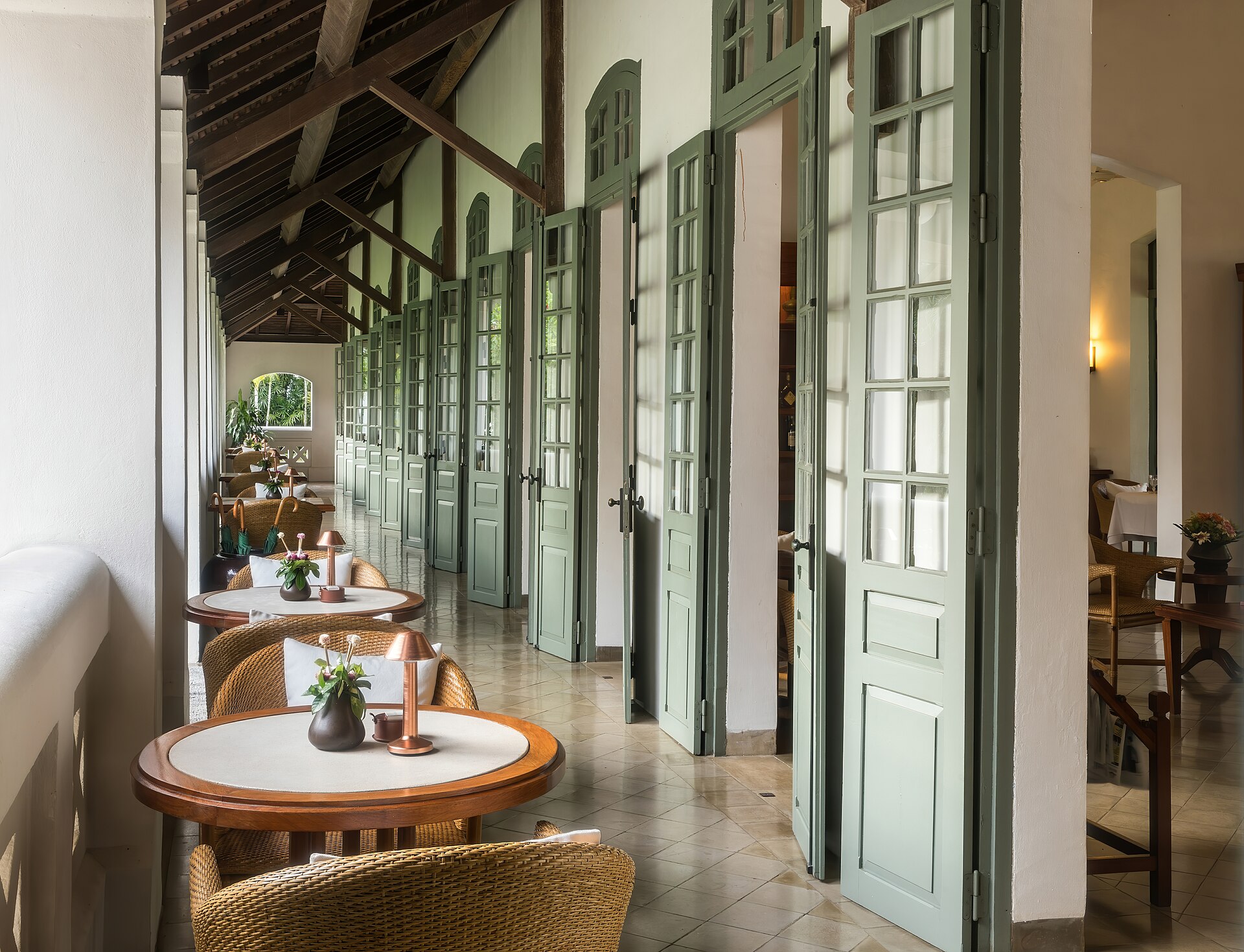
The restaurant at Amantaka, in Luang Prabang, is exactly that. Shot from a corner, at 35 mm, aperture f/16. The tables run one after another. The room looks like a place you could walk.
Sitting down beside the table
50 mm feels like sitting down at the table. The napkin, the glass and the fold of the cloth come into the frame. The background softens, and it does not vanish. Breakfast is told this way.
85 mm leans in toward the plate itself. Sauce, steam and the crust of the bread come forward. A cocktail glass steps out of the crowd the same way. For a moment you look only at that glass. The drink feels heavy, close, ready to be tasted.
We move closer still for cloth, for a vein in the marble, for the relief on a bar of soap. A 100 mm macro grows the texture until it could sit in your palm. The expensive feeling often starts here. People only believe a material once they have come close to it.
Open the aperture for these frames. Between f/2 and f/2.8 the hole is wide and the background falls apart. Not everything has to be sharp. Let the sharp thing be the thing you want to touch.
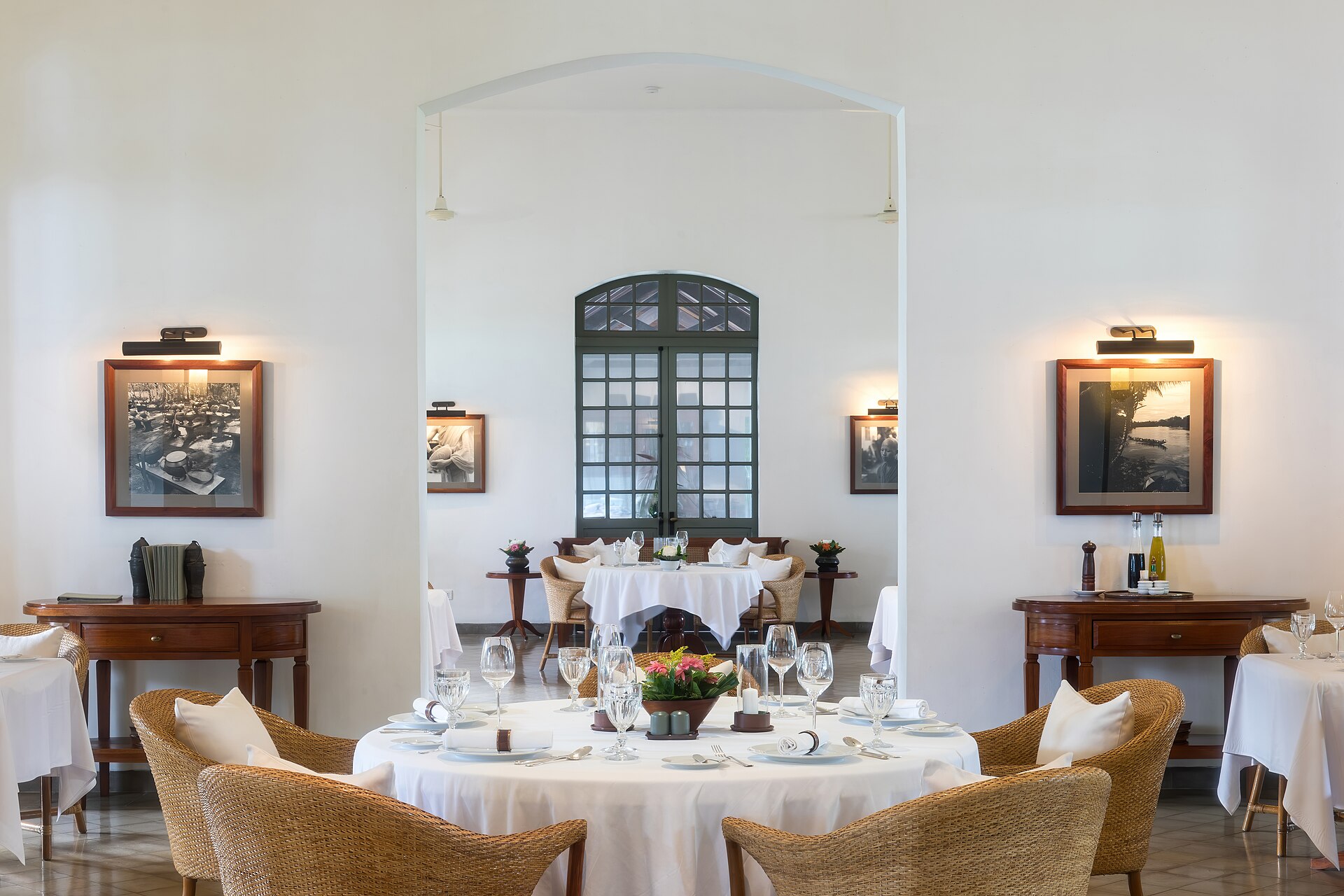
The table below is in the same hotel, at 50 mm. The aperture is f/14, so it is closed down. The glass stays, and the room stays with it. Open the aperture and only the plate would remain. The room would fall away. What you have here is simpler. You have sat down beside the table.
A room shot at 16 mm makes a promise it cannot keep
Shoot a 17 square metre room at 16 mm and the bed shrinks while the floor grows. The photo smiles like a suite. The guest opens the door and their face falls. Here a wide angle is not generosity. It is a promise you did not keep.
24 mm is enough for a room. The bed, the window and one corner stay together. The walls are still walls. Put the camera in the corner and those three enter the same glance. 35 mm is more intimate. It does not promise a hall. It says you can sit here, and you can sleep here.
A very small bathroom may need 16 mm. If the shower and the basin have to be told in one frame, that is fitting them in, not lying. If the tap stretches at the edge, step back and move up to somewhere between 20 and 24 mm. A shift lens saves you at a mirrored basin. Keep your body outside the mirror and slide the lens sideways, and you stay out of the glass. The lines stay upright too.
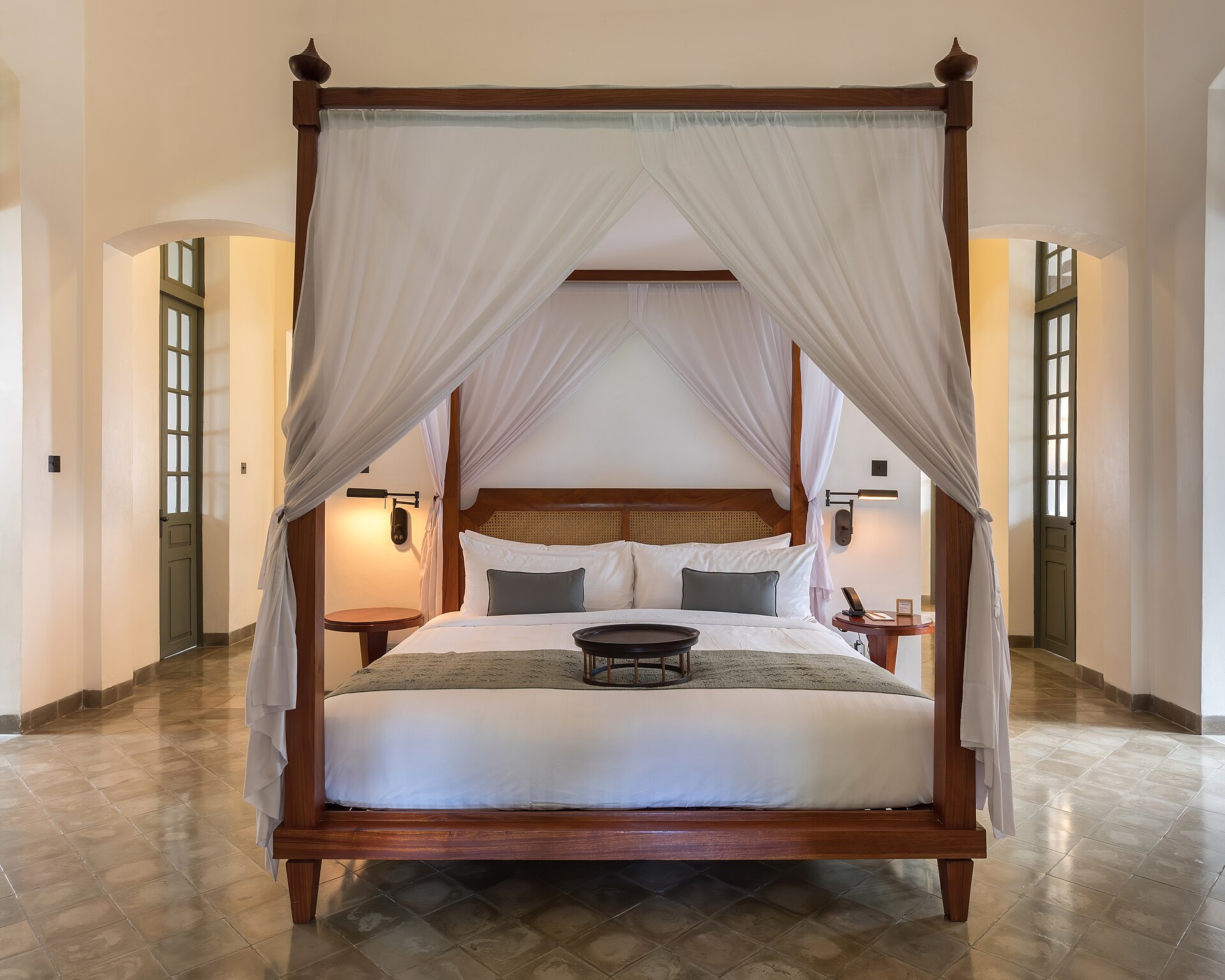
The bed below is at Amantaka. Full frame, 20 mm, f/11. The suite is large. The bed is still a bed, the doors are where doors should be, and the walls are walls. Drop to 16 mm and the floor would grow while the bed shrank.
In a corridor, the end should stay visible
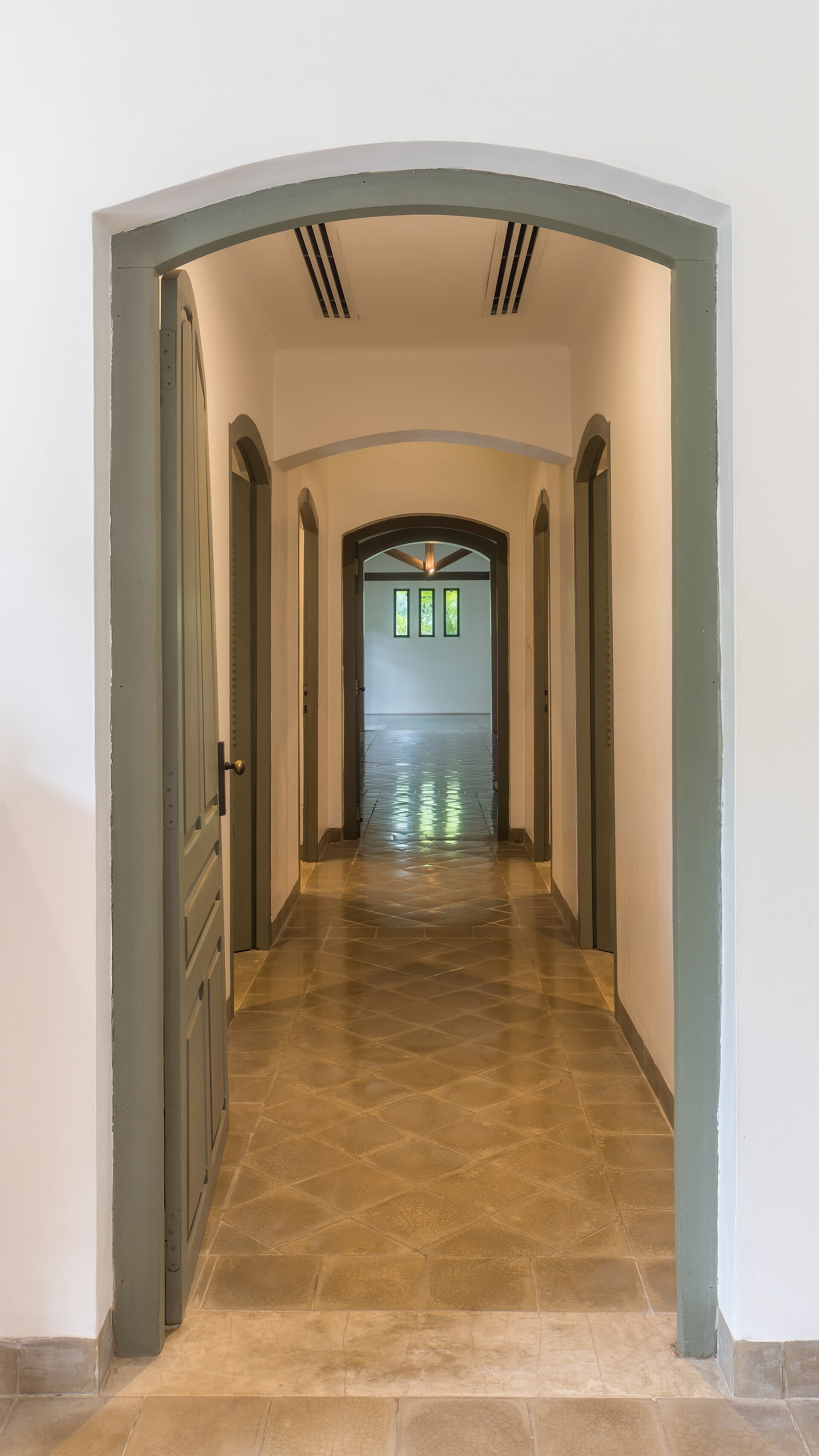
At 16 mm a corridor becomes a tunnel that never ends, and the doors recede. At 35 mm it keeps the rhythm of the doors. You can walk it, and the end does not disappear.
This corridor is in the spa at Amantaka. Full frame, 28 mm, f/13. About as calm as 35 mm. The doors keep their rhythm, and you can see the end.
The building has to stand upright
Stand in the street and look up with a 16 mm, and the building leans back. The hotel becomes a tower that might fall. Nobody wants to walk through a door like that.
The lens that sets this right is a 24 mm that can shift. It is called a tilt-shift. It has two movements. Shift slides the lens parallel to the body. The body stays upright, the lens rises, and the lines stay vertical. The building stands up. A tall lobby works the same way. Tip the camera toward the ceiling and the walls close in on each other. Shift the lens and they do not.
Tilt tips the focus. Along a long table it keeps both the near plate and the far plate readable. On a facade, the heart of the job is shift.
If you do not have a tilt-shift, step back. Photograph the facade straight on at 35 or 50 mm. You will not have to look up. Straightening the lean later, on the computer, bends the glass and eats the corners.
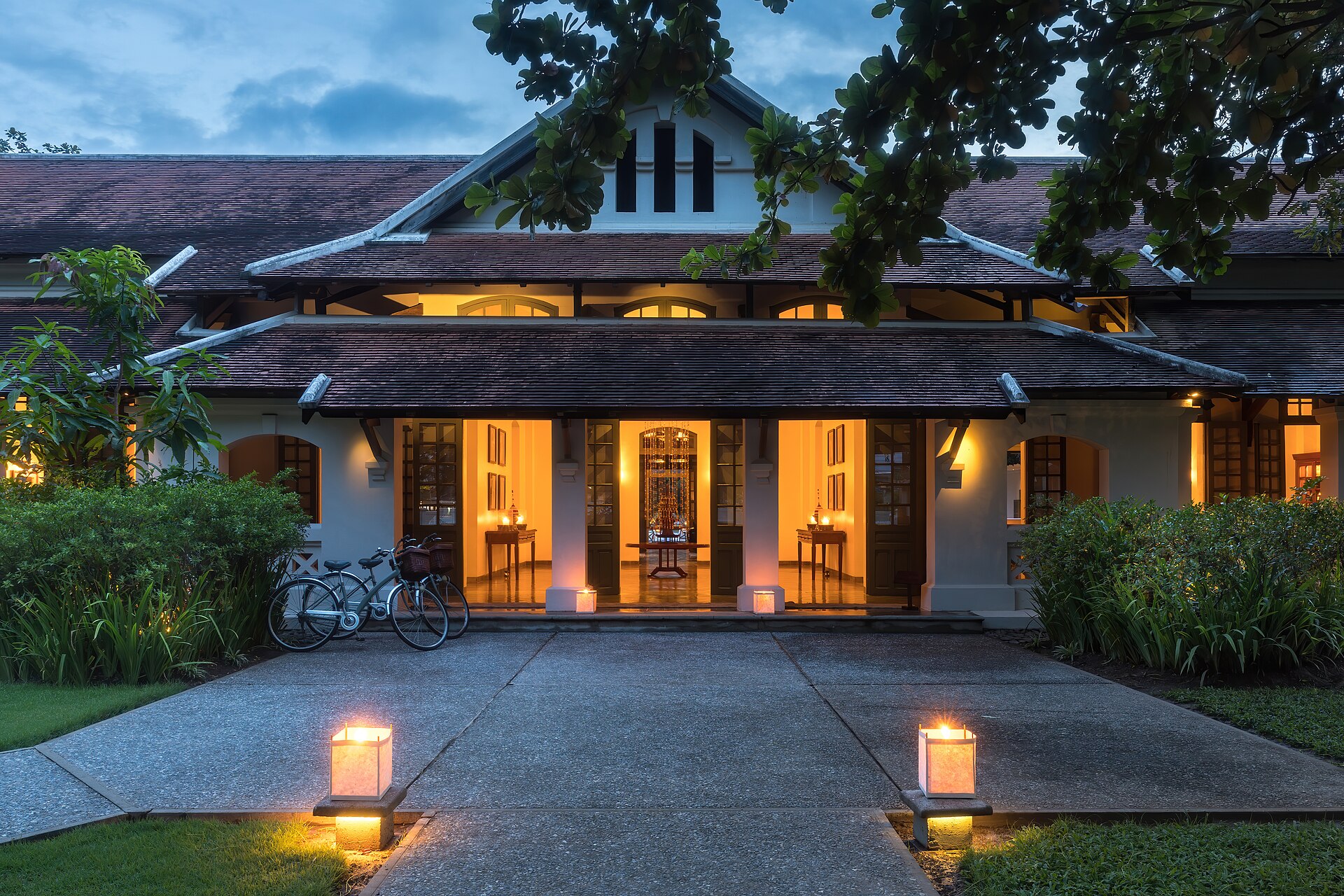
The door at Amantaka is 26 mm, shot from the front, in the early evening. It is not a tilt-shift. Nobody looked up. The building is standing. This is a door you would walk through.
Three lenses are enough in the bag
Three lenses in the bag are enough for most hotels. A 16-35 mm for the lobby and the large rooms. A 35 or a 50 mm for the guest room, the corridor and the table. An 85 mm for the plate, the glass and the cloth. If the building itself is going to speak, put a 24 mm tilt-shift beside them.
Ask once before you press the shutter. Is this frame making the room bigger, making you love the material, or keeping the building on its feet? The lens is the answer.